You touch the glass, it feels warm, and you assume your reptile is comfortable. The trouble is that “warm to your hand” and “right for a cold-blooded animal” can be 15 degrees apart. A heat lamp running unchecked may push the basking spot too high by afternoon, then leave the enclosure chilly by midnight.
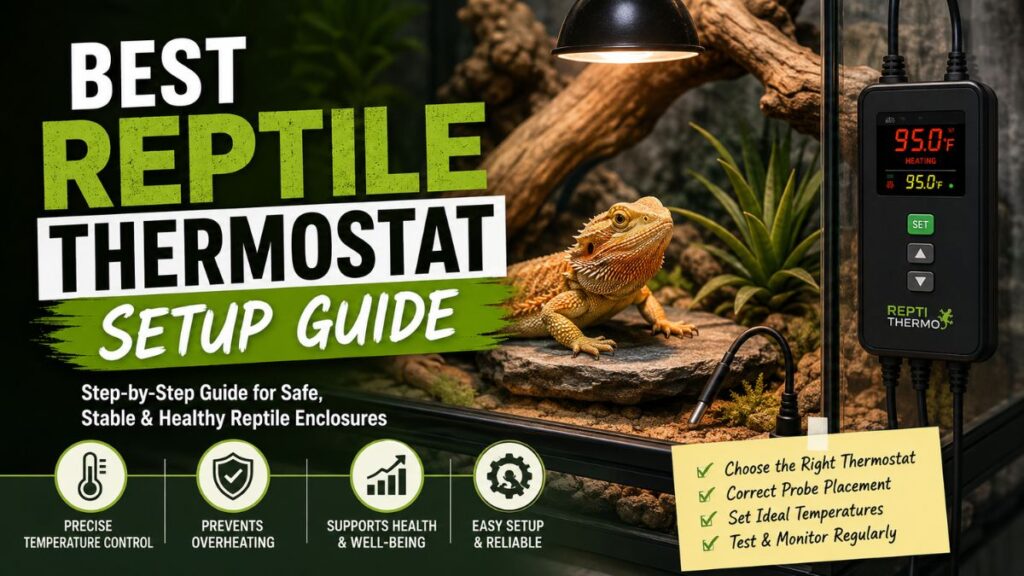
That’s the problem a reptile thermostat solves. It reads the temperature, switches your heater on and off for you, and keeps conditions steady while you sleep, work, or travel. In this guide, you’ll learn which type to buy, how to place the probe, how to set everything up safely, and the mistakes that catch even experienced keepers off guard.
Why Stable Heat Matters More Than You Think
Reptiles can’t make their own body heat. They borrow it from their surroundings, moving between warm and cool zones to digest food, fight infections, and stay active. If the warm zone is unreliable, their whole routine suffers.
What Happens When Temperatures Swing
- Too cold: slow digestion, refused meals, regurgitation, and a weaker immune system
- Too hot: stress, dehydration, burns, and in serious cases, overheating
- Constant swings: inconsistent appetite, poor shedding, and an animal that never fully settles
The good news is that most of these problems are preventable with the right equipment.
Why a Plug-In Timer Isn’t Enough
A timer only controls when the heater runs. It has no idea whether your room is 18°C on a winter night or 35°C on a summer afternoon. A thermostat responds to the actual temperature, so your setup adapts even when the weather doesn’t cooperate.
Choosing the Right Thermostat Type
Not every thermostat works with every heater. Pairing the wrong ones is one of the most common setup errors, and it can damage equipment or create real hazards.
On/Off Thermostats
These are the simplest and usually the cheapest. The heater runs at full power until it reaches your target, then shuts off until the temperature drops.
- Works for heat mats and ceramic heat emitters in many setups
- Temperatures can drift a few degrees above and below your target
- Not ideal for light-emitting bulbs, since constant clicking on and off can startle your animal and shorten bulb life
Pulse Proportional Thermostats
Instead of switching fully on or off, these send rapid pulses of power to hold the temperature close to your target. Most keepers see much tighter control, often within a degree or two.
- Best for heat mats, ceramic heat emitters, and radiant heat panels
- Never use with bulbs that give off light, because the pulsing causes flicker
Dimming Thermostats
These lower the voltage smoothly, so a basking bulb simply glows a little softer instead of switching off.
- Made for incandescent and halogen basking bulbs
- Not suitable for ceramic heat emitters, fluorescent tubes, or most mercury vapor bulbs
Confused about dimming thermostat vs pulse proportional thermostat? Use this shortcut: if the heater gives off light, choose dimming. If it gives off only heat, choose pulse proportional.
Matching the Thermostat to Your Heat Source
Best Thermostat for Bearded Dragon Setups
Adult bearded dragons need a hot basking spot, usually 100–110°F (38–43°C) at surface level, which means a basking bulb. The best thermostat for bearded dragon enclosures is therefore a dimming model controlling that bulb. It keeps the light on all day, which is better for your pet, while holding the heat steady.
Your UVB tube should stay on its own timer, never on a thermostat.
Heat Mats and Under-Tank Setups
Leopard geckos, corn snakes, and ball pythons often rely on belly heat. If you’re shopping for a reptile thermostat for heat mat use, a pulse proportional model is the safest choice. A mat without a thermostat can overheat quickly and cause burns, so never run one unregulated.
Check Wattage Before You Buy
Every thermostat has a maximum wattage rating. Your heater must sit comfortably below it, with room to spare. If you run two heaters on one controller, add their wattages together.
Not sure your pairing is safe? The Reptile Thermostat Compatibility Calculator helps you check whether your thermostat and heater make a good match before you plug anything in.
What to Look For Before You Buy
Features Worth Paying For
- A clear digital display
- High and low temperature alarms
- Day/night programming
- A long probe cable
- Safety certification marks for your region
- A clearly stated wattage rating
Features You Can Skip
Fancy extras rarely improve control. Wi-Fi alerts are handy if you travel often, but they never replace a reliable, well-matched controller. Spend your budget on build quality and the right type for your heater.
How to Set Up a Reptile Thermostat Step by Step
Here’s the process most experienced keepers follow, in the order that works best.
What You’ll Need
- A thermostat with a probe that matches your heater type
- Your heat source (lamp, mat, or emitter)
- A separate digital thermometer or temperature gun
- Heat-safe tape and probe clips
- A ceramic lamp socket if you’re using a bulb
Place the Probe Correctly
Probe placement matters more than the thermostat’s price tag. A badly placed probe tells the controller the wrong story.
- Basking lamp: position the probe at basking-surface height, off to the side and shaded so light doesn’t hit it directly
- Heat mat: tape it flat to the mat surface or directly above it, following the manufacturer’s instructions
- Always: secure the cable so your animal can’t chew, move, or bury the probe
Test Everything Before Your Pet Moves In
Plug the thermostat into the wall, then plug the heater into the thermostat. Set your target and let it run for 24 to 48 hours with the enclosure empty. Compare readings against your separate thermometer at several times of day, including overnight.
Fine-Tune Slowly
If readings are off, adjust by a degree or two, then wait an hour before changing again. Chasing the perfect number with constant tweaks usually causes more confusion than it solves.
Starting Temperatures for Popular Species
Treat these as starting points and confirm them against a species-specific care sheet.
- Bearded dragon: basking 100–110°F (38–43°C); cool side 75–85°F (24–29°C)
- Leopard gecko: warm surface 88–92°F (31–33°C); cool side 75–80°F (24–27°C)
- Ball python: warm side 88–92°F (31–33°C); cool side 78–80°F (26–27°C)
- Corn snake: warm side 80–85°F (27–29°C); cool side 70–75°F (21–24°C)
Day and Night Settings
Many thermostats let you program a lower nighttime target. Some species handle a gentle drop well, while others need steadier warmth, so check your animal’s needs before programming. Always measure the result with your second thermometer.
Common Mistakes to Avoid
Setup Mistakes
- Using a dimmer with a ceramic heat emitter
- Placing the probe in direct light or far from the heat source
- Skipping the separate thermometer
- Exceeding the thermostat’s wattage rating
- Plugging a UVB tube into the thermostat
Safety Backups Worth Having
A thermostat is a helper, not a guarantee. Probes can drift and units can fail. Consider a high-limit cutoff device, guard every bulb so nothing can touch it, keep cables away from water, and check your readings weekly. A few minutes of routine checks can prevent a serious emergency.
FAQs
Do I really need a thermostat for my reptile’s heater?
If you use a heat lamp, mat, or ceramic emitter, yes. Unregulated heaters can overheat or swing with room temperature, and a thermostat costs far less than an emergency vet visit.
Can I connect my UVB light to a thermostat?
No. UVB lighting should run on a timer, and many fluorescent tubes aren’t compatible with dimming or pulsing.
Where should I place the thermostat probe?
Put it where your animal actually feels the heat: basking-surface height for lamps, or against the mat surface for belly heat. Keep it shaded from direct light and out of reach.
Is a dimming or pulse proportional thermostat better?
Neither is better overall. Dimming suits light-emitting basking bulbs, while pulse proportional suits heat sources that don’t produce light.
Conclusion
A reliable setup isn’t about expensive gear. It’s about matching the right thermostat to the right heater, placing the probe where it counts, and testing before your animal moves in. Get those three things right, and you can rest easier knowing the habitat stays steady around the clock.
Here’s a simple plan:
- Identify your heat source and its wattage
- Choose the thermostat type that matches it
- Run it empty for 24–48 hours and compare against a second thermometer