
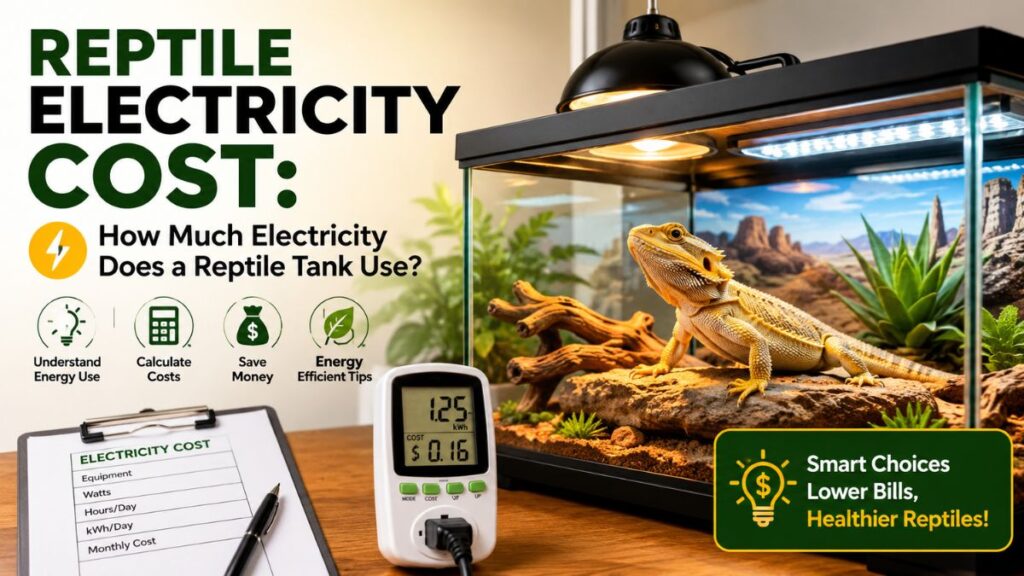
You brought home a bearded dragon, a ball python, or a leopard gecko, and the first few weeks felt amazing. Then the power bill arrived. Now you’re staring at that glowing basking lamp and wondering what it’s really costing you.
It’s a fair question, and most care sheets skip it. Your reptile electricity cost comes down to a few simple factors, and once you know them, you can predict your bill within a dollar or two. In this guide, you’ll see the wattage of common tank equipment, real monthly examples, and the mistakes that quietly inflate the bill, along with practical ways to trim it without putting your animal’s health at risk.
What Drives Your Reptile Electricity Cost
So, how much electricity does a reptile tank use? Less than most people think. Reptile keeping isn’t a power-hungry hobby, and most single enclosures cost less per month than a streaming subscription. The bill only climbs when you run several tanks or use bulbs stronger than your animal needs.
The Simple Formula Behind Every Bill
Electricity is billed in kilowatt-hours (kWh), which simply means using 1,000 watts for one hour. To estimate any device, use this:
Watts × hours per day ÷ 1,000 × 30 days × your rate = monthly cost
Example: a 100W basking bulb running 12 hours a day uses 1.2 kWh daily, or 36 kWh a month. At $0.17 per kWh, that’s about $6.12.
Why Your Local Rate Changes Everything
Rates vary a lot. Some regions pay around $0.10 per kWh, while others pay $0.30 or more. Check your latest bill for the price per kWh. Every example below uses $0.17 as a round middle figure, so just swap in your own number.
Hours Matter as Much as Watts
A basking lamp may run 10 to 12 hours, while a night heater could run until morning. But anything controlled by a thermostat only draws power part of the time, so it uses far less than its label suggests. That duty cycle is the biggest hidden factor in your bill.
What Common Reptile Tank Equipment Uses
Most of what you plug in falls into four groups. Always check the wattage printed on the label, since brands differ.
Heat Lamps and Basking Bulbs
Basking bulbs are usually the biggest power draw in the tank. Here’s what they cost at 12 hours a day:
- 50W: about $3.06 a month
- 75W: about $4.59 a month
- 100W: about $6.12 a month
- 150W: about $9.18 a month
UVB Lighting
UVB is cheaper than most owners expect. A 24W T5 HO tube costs about $1.47 a month, and a 13W compact UVB about $0.80. Mercury vapor bulbs (100 to 160W) give heat and UVB together, so their cost is similar to a basking lamp, but they replace two separate bulbs.
Ceramic Heat Emitters and Heat Mats
Ceramic heat emitters (typically 60 to 150W) give off heat without light, which makes them popular at night. Heat mats are gentler, usually 8 to 40W, but they warm surfaces rather than air. Both should always be connected to a thermostat.
The Small Stuff: Thermostats, Timers, and LEDs
Thermostats draw only a watt or two, and timers are similarly tiny. A 10W LED running 12 hours costs about $0.61 a month. These are pennies, so don’t lose sleep over them.
Real-World Monthly Cost Examples
Let’s put the numbers together using the same $0.17 rate. These are estimates, but they show the typical range for popular pets.
Bearded Dragon Tank Electricity Cost per Month
A typical adult setup looks like this:
- 100W basking bulb, 12 hours: 36 kWh
- 24W T5 UVB tube, 12 hours: 8.6 kWh
- 10W LED light, 12 hours: 3.6 kWh
That’s about 48 kWh, or roughly $8.20 a month. A dimming thermostat can push it lower, because the bulb doesn’t burn at full power all day.
Ball Python Setup
Pythons often use a 100W ceramic heat emitter on a thermostat. If it runs about half the time across 24 hours, that’s 36 kWh, or $6.12. Add a small 5W LED and you’re near $6.40 a month. In a warmer room, the emitter cycles even less.
Leopard Gecko Setup
A 20W heat mat running half the time costs about $1.22 a month. Add a 14W UVB tube for 12 hours a day ($0.86) and the whole tank lands at roughly $2 a month. Small animals really do mean small bills.
What About Multiple Tanks?
It scales quickly. Ten bearded-dragon-style enclosures would cost close to $80 a month. If you keep a collection, small savings on each tank turn into real money by the end of the year.
Heat Lamp vs Ceramic Heat Emitter: Which One Costs More?
This is one of the most common questions new keepers ask, and the answer surprises people.
The Surprising Truth
Almost all the electricity a heater uses ends up as heat, so cost depends on wattage and hours, not bulb type. When you compare heat lamp vs ceramic heat emitter running cost, a 100W lamp and a 100W emitter cost exactly the same to run.
How to Choose
So choose based on what your reptile needs, not on price:
- Heat lamp: daytime basking, plus visible light for day-active species
- Ceramic heat emitter: nighttime warmth without disturbing sleep
- Either way: use a thermostat and a bulb guard so your animal can’t touch the hot surface
Smart Ways to Cut Heating Bills Without Stressing Your Reptile
If you want to reduce reptile heating costs, the goal is never to run the tank cooler than your species needs. It’s to stop wasting watts.
Use a Thermostat on Every Heat Source
A thermostat is both a safety tool and a money saver. It switches heat off once the target temperature is reached, so you pay only for the warmth you actually use. Proportional or dimming models are the most efficient.
Insulate the Enclosure
Cover the back and sides with foam board, leaving ventilation intact. Keep tanks away from windows, drafty doors, and air-conditioning vents. Heat that stays in means a heater that rests more.
Right-Size Your Wattage
Bigger isn’t better. An oversized bulb wastes power and can overheat the enclosure. Use an infrared temperature gun to measure the basking spot, then pick the lowest wattage that reaches your species’ recommended range.
Adjust for the Season
Winter raises costs because your room is colder. Check temperatures every season and adjust wattage, bulb height, or insulation instead of leaving everything on autopilot.
Common Mistakes That Quietly Inflate Your Bill
These habits cost more than any single bulb.
Running Heat Without a Thermostat
Plugging a heater straight into the wall means it runs at full power nonstop. That wastes electricity and risks overheating your animal.
Using Two Heat Sources Where One Would Do
Many setups stack a heat mat, a lamp, and an emitter. Often one properly sized, thermostat-controlled source holds the temperature better and costs less. Add extras only when your readings show a real gap.
Leaving Lights On Too Long
Reptiles need a steady day and night rhythm, usually 10 to 12 hours of light depending on species and season. Extra hours don’t help your animal and just add to the bill.
Guessing Instead of Measuring
A cheap digital probe and an infrared gun show whether you’re heating too much or too little. Measuring protects both your pet and your wallet.
How to Calculate Your Own Tank’s Electricity Use
Your setup is unique, so a quick calculation beats any average.
Step by Step
- List every device and its wattage from the label.
- Note the daily hours each one runs. For thermostat-controlled heaters, estimate 40 to 60 percent of the time.
- Multiply watts by hours, then divide by 1,000 to get daily kWh.
- Multiply by 30, then by your electricity rate.
- Add every device together.
Skip the Math With a Calculator
Prefer not to do it by hand? Try our Reptile Enclosure Lighting Cost Calculator. Enter your bulb wattage, daily hours, and local rate, and you’ll see monthly and yearly costs instantly. It’s also handy for comparing bulbs before you buy.
Frequently Asked Questions
How much electricity does a reptile tank use per day?
A bearded-dragon-style setup with a heat lamp, UVB, and LED uses roughly 1.5 to 2 kWh a day. A small gecko tank is closer to 0.4 kWh. Your exact number depends on wattage and how long each device runs.
Is it expensive to keep a reptile warm all year?
Not usually. In the examples above, a single tank costs about $2 to $9 a month. Larger enclosures, higher-wattage bulbs, and cold winters can push that higher.
Do I need to leave reptile heat on at night?
It depends on the species and your room temperature. Many reptiles need a nighttime temperature drop, but some, like ball pythons, need extra warmth if the room gets too cool. Follow your species’ care guidelines and use a thermostat with a light-free heat source.
Does a thermostat really save electricity?
Yes. It cycles or dims the heater so it only draws power when needed. It also prevents overheating, which makes it one of the best upgrades you can buy.
Conclusion
Your reptile doesn’t need a huge power bill to thrive. You now know the formula, the wattage of common gear, and the habits that waste money. Reptile electricity cost is really a matter of right-sized bulbs, smart timing, and a good thermostat.
Here’s your next step: grab your latest electricity bill, find your rate, and list every device on your tank. Then run the numbers with the Reptile Enclosure Lighting Cost Calculator and see where you can save. A few small changes today can lower your bill all year.