Have you ever looked at your pet reptile and wondered, “How old is it really?” Whether you adopted a rescue, purchased a reptile without complete records, or simply want to learn more about your pet, estimating reptile age can be both fascinating and useful.
Knowing your reptile’s approximate age helps you provide proper nutrition, housing, healthcare, and overall care. Different life stages require different feeding schedules, enclosure setups, and health monitoring. While determining an exact age is often impossible without hatch records, several clues can help you make a surprisingly accurate estimate.
In this guide, you’ll learn practical methods used by reptile keepers and veterinarians to estimate age and better understand your scaly companion.
Why Knowing Your Reptile’s Age Matters
Better Nutrition and Feeding
Young reptiles generally require more frequent feeding and higher protein intake than adults. Knowing the approximate age helps you avoid underfeeding or overfeeding.
Proper Habitat Requirements
As reptiles mature, their enclosure needs often change. Adult reptiles may require larger habitats, stronger lighting, or different temperature gradients.
Health Monitoring
Age affects health risks. Older reptiles may develop issues that younger animals rarely experience, making age estimation an important part of preventive care.
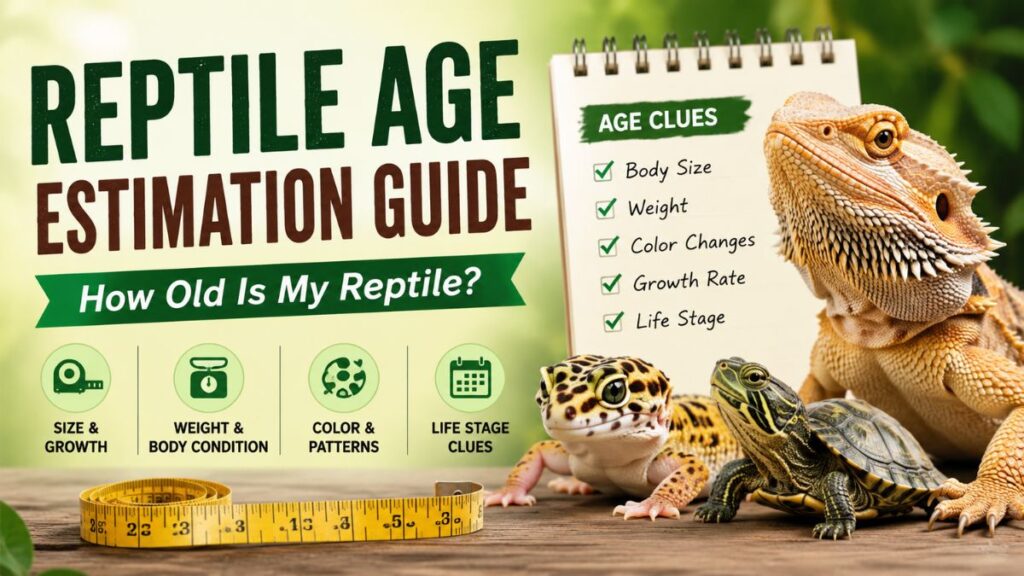
Reptile Age Estimation Guide: Key Signs to Look For
Body Size and Length
One of the easiest starting points is measuring your reptile’s size.
Many species follow predictable growth patterns during their first few years. Comparing your reptile’s length and weight to species-specific growth charts can provide valuable clues.
Keep in mind:
- Growth rates vary by species.
- Diet quality affects development.
- Environmental conditions influence growth speed.
- Genetics can cause significant differences.
Weight and Body Condition
A healthy juvenile often has a different body composition than an adult.
For example:
- Young reptiles typically appear slimmer.
- Mature reptiles develop fuller muscle mass.
- Older reptiles may show reduced muscle tone.
Combining weight measurements with body length often improves accuracy.
Color and Pattern Changes
Many reptiles change appearance as they mature.
Examples include:
- Juvenile coloration fading with age.
- Adult patterns becoming more pronounced.
- Scale texture changing over time.
These visual clues can be especially helpful when estimating the age of common pet reptiles.
Growth Stages in Common Pet Reptiles
Hatchling Stage
Hatchlings are newly born or newly hatched reptiles.
Characteristics often include:
- Small body size
- Bright coloration
- Rapid growth rates
- Frequent feeding requirements
Juvenile Stage
Juveniles experience their fastest growth period.
Typical signs include:
- Noticeable size increases
- Frequent shedding
- High activity levels
- Developing adult features
Adult Stage
Most reptiles eventually reach a point where growth slows significantly.
Adult indicators include:
- Stable body size
- Mature coloration
- Established body proportions
- Reduced growth rate
Senior Stage
Senior reptiles may display:
- Slower movement
- Changes in appetite
- Duller coloration
- Increased health monitoring needs
How to Estimate Reptile Age by Size
Compare With Species Growth Charts
Species-specific growth charts remain one of the most reliable methods available.
For example:
- A young leopard gecko grows rapidly during its first year.
- Many bearded dragons reach near-adult size within 12 to 18 months.
- Larger reptiles may continue growing slowly for several years.
Researching your exact species can dramatically improve age estimates.
Consult a Reptile Veterinarian
Experienced reptile veterinarians often recognize age-related characteristics that are easy for owners to miss.
A professional examination may include:
- Body condition assessment
- Scale evaluation
- Skeletal development observations
- Species-specific growth comparisons
Factors That Affect Reptile Growth Rate
Diet Quality
A reptile receiving optimal nutrition often grows faster than one fed an inadequate diet.
Temperature and Lighting
Proper heat and UVB exposure support healthy development. Poor environmental conditions can slow growth significantly.
Genetics
Even within the same species, growth rates vary. Some individuals naturally grow larger or mature faster than others.
Health History
Previous illnesses, parasites, or poor husbandry may affect growth patterns and complicate age estimation.
Use an Online Reptile Age Calculator
A Quick and Convenient Tool
If you know your reptile’s species, size, and basic details, an age calculator can provide a helpful estimate.
You can try the Reptile Age Calculator here:
https://reptilecalc.com/tool/reptile-age-calculator/
While no calculator can guarantee exact results, it offers a practical starting point for understanding your pet’s life stage and care requirements.
FAQs:
Can you determine a reptile’s exact age?
In most cases, no. Unless hatch records exist, age estimates are based on physical characteristics, size, and growth patterns.
Does shedding frequency indicate age?
It can help. Younger reptiles generally shed more often because they grow faster, but shedding alone is not a reliable age indicator.
Are larger reptiles always older?
Not necessarily. Diet, genetics, and environmental conditions can influence growth, making size only one part of age estimation.
Conclusion:
Estimating your reptile’s age may not provide an exact number, but it can offer valuable insights into your pet’s health, nutritional needs, and overall care. By evaluating size, weight, coloration, growth patterns, and life-stage characteristics, you can make a much more informed estimate.