
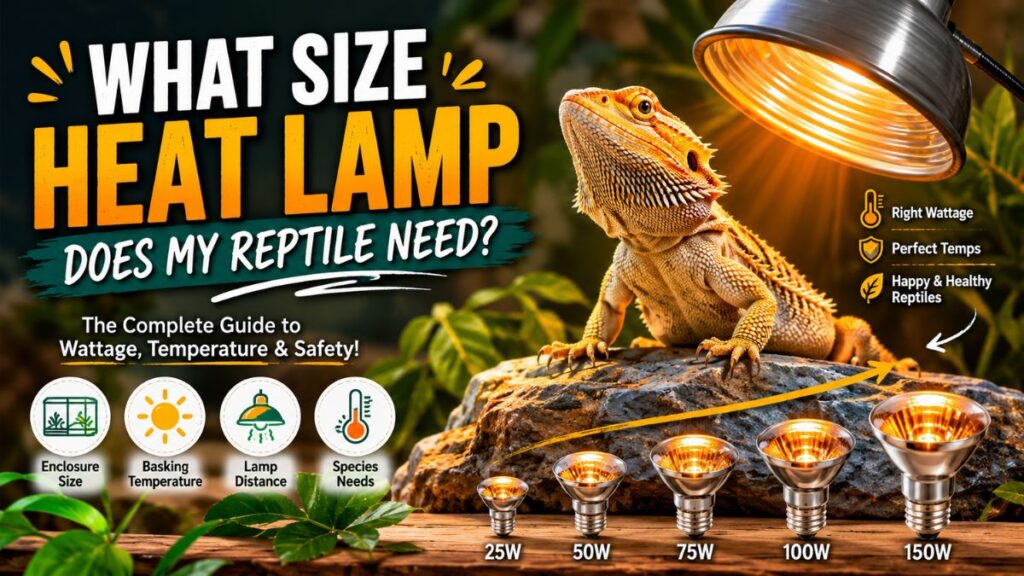
You’ve built the enclosure, picked the perfect hide, and now you’re staring at a wall of bulbs: 40 watt, 75 watt, 100 watt, 150 watt. Which one keeps your pet comfortable, and which one could cook it?
Getting the right reptile heat lamp wattage matters more than most new keepers realize. Reptiles can’t warm themselves from the inside, so your lamp does the job the sun would do in the wild. Get it wrong and you may see poor appetite, stuck shed, or a pet that hides all day.
In this guide, you’ll learn how to match wattage to your species and tank size, how to tell whether your setup is actually working, and why the strongest bulb on the shelf is often the wrong pick.
Why Proper Heat Matters So Much
Digestion and Immunity
Reptiles rely on external heat to digest food and fight off illness. When basking temperatures are too low, meals can sit undigested and immune function suffers.
Burns and Stress
On the other side, a bulb that’s too strong can cause thermal burns and chronic stress. Both problems are avoidable with the right wattage.
Why There’s No Single “Right” Number
Open three care sheets and you’ll find three different bulb recommendations for the same animal. They aren’t necessarily wrong. They’re describing different setups.
Wattage Measures Power, Not Warmth
Wattage tells you how much electricity a bulb uses. It says nothing about how warm your enclosure will get. What you actually care about is the surface temperature of the basking spot, the place where your reptile rests. Wattage is simply the tool that gets you there.
Picture two keepers using the same 100-watt bulb. One has a short tank in a warm room; the other has a tall enclosure in a cold basement. The first may overheat a pet, while the second wonders why nothing feels warm. Same bulb, opposite results.
What Changes the Answer
Your ideal bulb depends on a handful of factors:
- Enclosure size and height: heat fades with distance, so tall tanks need more power
- Room temperature: a chilly winter room needs more help than a warm apartment
- Lid type: screen tops let heat escape, while solid tops hold it in
- Bulb distance: a closer bulb delivers more heat from fewer watts
- Species: a desert dweller needs a far hotter basking spot than a rainforest gecko
Starting Wattage by Enclosure Size
So, how many watts does a basking bulb need? Treat these ranges as starting points for your reptile heat lamp wattage, not final answers. A thermometer always gets the last word.
Small Enclosures (10–20 Gallons)
- Typical range: 25–50 watts
- Best for hatchlings, small geckos, and small snakes
Small tanks heat up fast. A bulb that’s too strong can overheat the whole space within an hour and leave your pet with nowhere cool to retreat.
Medium Enclosures (40 Gallons)
Plenty of keepers search for the best heat lamp wattage for a 40 gallon tank, and the honest answer is that it depends on who lives inside:
- Juvenile bearded dragon: 75–100 watts
- Ball python: 50–75 watts, ideally on a thermostat
- Leopard gecko: 25–50 watts
Large Enclosures (75 Gallons or 4×2×2 Feet)
Bigger and taller spaces lose more heat, so you’ll often need 100–150 watts. Another option is two lower-wattage bulbs side by side, which creates a wider basking zone and makes fine-tuning easier. Mesh lids are a common reason a bulb seems too weak, since they let heat escape.
Wattage Guide by Species
Bearded Dragon Heat Lamp Wattage
Bearded dragons are true sun-worshippers. Their basking surface should reach roughly 95–110°F, with juveniles at the warmer end and adults slightly lower. Most keepers land on a 75–150 watt halogen flood bulb, depending on tank size and bulb height. Adults in large enclosures often do best with 100–150 watts, while juveniles in smaller tanks may only need 75. Halogen bulbs give heat but no UVB, so your dragon still needs a separate UVB light.
Ball Python Heat Lamp Wattage
Ball pythons prefer a warm side around 88–92°F and a cool side near 78–80°F. They don’t need bright light, so a 40–75 watt bulb on a thermostat works well. Many keepers choose a ceramic heat emitter instead, which makes heat without light. Either way, add a bulb guard. Snakes love to coil around heat sources and can burn themselves quickly.
Leopard Geckos and Crested Geckos
Leopard geckos like a warm-side surface of about 88–92°F, and a 25–50 watt lamp on a thermostat usually does the job.
Crested geckos are different. Most are comfortable at 72–78°F and don’t need a heat lamp at all. If your room drops below about 68°F, a 15–25 watt low-output bulb can help. For cresties, overheating is a bigger danger than a cool room, so keep the enclosure under 80°F.
Other Popular Species at a Glance
A few more quick references:
- Blue-tongued skinks: basking surface around 95–105°F, usually 60–100 watts depending on bulb height
- Corn snakes: warm side near 80–85°F, so 25–50 watts on a thermostat is plenty
Picking the Right Type of Heat Bulb
Wattage is only half the story. The type of bulb changes how that wattage behaves.
Halogen Flood Bulbs
These are the go-to choice for basking spots. They produce bright, intense heat, they dim well, and they’re easy to find. They work best for daytime use with sun-loving species.
Ceramic Heat Emitters
Ceramic emitters give off heat with no visible light, which makes them ideal for nighttime warmth and for nocturnal species. Pair them with a compatible thermostat and a ceramic socket fixture.
Mercury Vapor Bulbs
These produce heat and UVB in one bulb, usually at 100 watts or more. They can’t be dimmed, so you control temperature by adjusting distance. Great for larger enclosures, but they need careful setup.
How to Choose the Right Reptile Heat Lamp Wattage Step by Step
Here’s a simple process that works for almost any species.
Step 1: Find Your Species’ Target Temperatures
Look up the ideal basking and cool-side temperatures for your animal from a trusted care guide or your reptile vet. Write both numbers down. Every other decision depends on them.
Step 2: Start Low, Then Measure
Pick a bulb from the lower end of the ranges above. Let it run for 30–60 minutes, then use an infrared temperature gun to measure the basking surface, not the air. Cheap stick-on dial thermometers can be off by several degrees, so don’t trust them alone. Check again at different times of day, since room temperature shifts from morning to evening.
Step 3: Adjust Height Before Swapping Bulbs
- Too cool? Lower the lamp or step up one wattage level
- Too hot? Raise the lamp or switch to a lower wattage
- Always keep a clear, cooler zone at the opposite end
As a rough guide, most halogen bulbs sit 8–12 inches above the basking surface, but check the packaging and always measure.
Want to skip the trial and error? The Reptile Heating Wattage Calculator can give you a starting point for your setup, so you can fine-tune from there instead of guessing.
Step 4: Add a Thermostat
A thermostat is the best safety upgrade you can make. For halogen bulbs, a dimming thermostat smoothly reduces power instead of switching the lamp on and off. It keeps temperatures steady when the weather changes and protects your pet if a bulb turns out stronger than you planned.
How to Read Your Reptile’s Body Language
Your pet will tell you if the wattage is off. You just need to know what to look for.
Signs It’s Too Hot
- Open-mouth panting or gaping
- Staying on the cool side all day
- Avoiding the basking spot completely
- Hiding constantly or trying to escape
Signs It’s Too Cold
- Little interest in food
- Sluggish movement or long hours sitting under the lamp
- Regurgitating meals or slow digestion
- Trouble shedding
Behavior is a clue, not a diagnosis. If something seems off for more than a day or two, check your temperatures first, then call your reptile vet.
Common Mistakes and Safety Checks
Buying the Biggest Bulb “Just in Case”
More watts isn’t safer. It’s how pets get burned. A 150-watt bulb in a small tank can push surface temperatures well past safe limits in minutes. Start low and work up.
Forgetting the Night Drop
Most species need a cooler, darker night. Run the lamp for about 10–12 hours a day, and if your room falls below your species’ night range, use a ceramic heat emitter instead of a lamp.
Ignoring the Fixture’s Rating
Every lamp dome has a maximum wattage printed on it. Going over that limit is a fire risk. Choose a ceramic-socket dome made for heat bulbs, since plastic clip lamps can melt.
Skipping the Bulb Guard
Keep every bulb out of your pet’s reach and away from plastic, cords, and décor. A wire guard costs a few dollars and can prevent a serious burn.
Frequently Asked Questions
Can I use a regular household bulb as a heat lamp?
Regular incandescent bulbs give off some heat, but halogen flood bulbs are far better for basking. LED and CFL bulbs make almost no heat, so they won’t work.
Does a heat lamp replace UVB lighting?
No. Most basking lamps produce heat only. Daytime species like bearded dragons need a separate UVB source, unless you use a mercury vapor bulb.
Do I still need a heat lamp if I have an under-tank heater?
It depends on the species. Basking species like bearded dragons need overhead heat, because an under-tank heater only warms the surface beneath it. Some geckos and snakes do well with belly heat plus a thermostat.
How often should I replace my heat bulb?
Bulbs lose output over time, even before they burn out. Check your basking temperature monthly with a temperature gun and replace the bulb when readings drop or when the manufacturer recommends.
Final Thoughts
The right reptile heat lamp wattage isn’t a magic number. It’s a match between your species, your enclosure, and your room. Start low, measure the basking surface, adjust the height, and let a thermostat keep things steady. Your pet will reward you with better appetite, smoother sheds, and more natural behavior.